
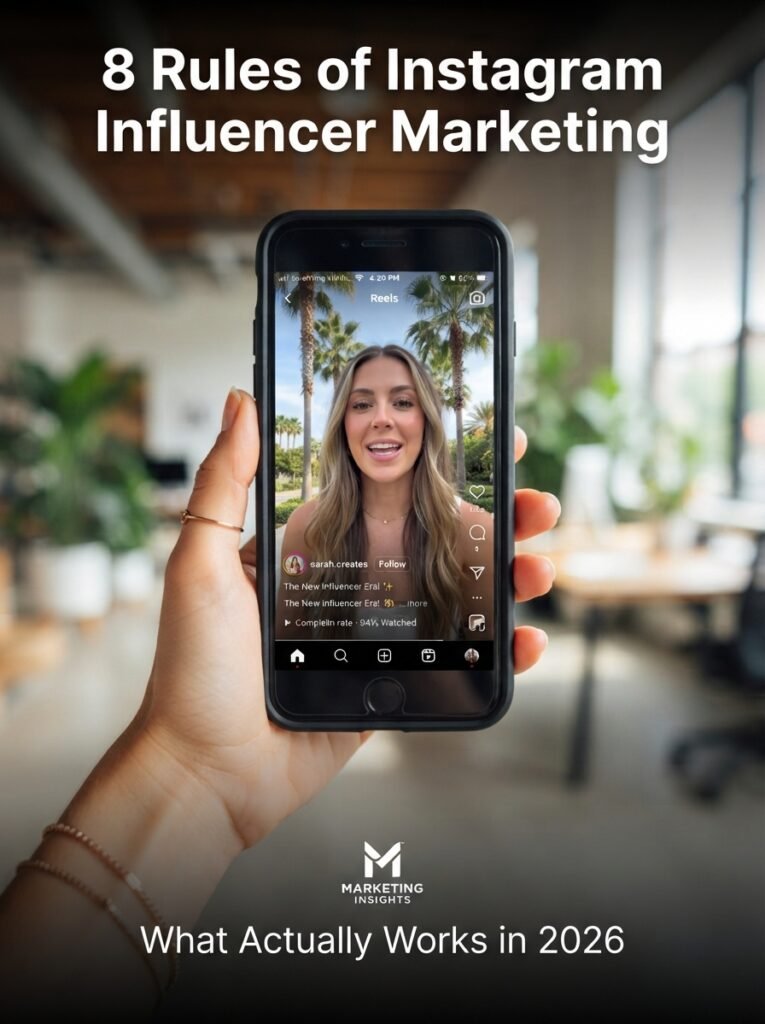
Running Instagram influencer marketing campaigns the same way brands did even two years ago is a fast way to underperform. Instagram Influencer Marketing That Actually Work The platform’s algorithm, content formats, and measurement signals have all shifted meaningfully, and briefs that don’t account for these changes tend to waste budget on content the algorithm was never going to reward in the first place. What worked reliably even eighteen months ago can quietly stop working without a brand ever realizing the underlying mechanics have moved on. Instagram Influencer Marketing That Actually Work Here are eight rules shaping effective Instagram influencer marketing in 2026, based on how the platform actually ranks and rewards content right now.
- Reels are the primary engine, not an optional format
- Brief around Instagram’s three core ranking signals
- Caption SEO is now a real ranking factor, not an afterthought
- Use the Collab feature to merge audiences instantly
- Balance evergreen and trend-based content deliberately
- Look beyond your own niche for storyfit creators
- Test creative with Trial Reels before committing paid budget
- Connect content directly to Shopping and conversion tools

Contents
- 1 Why Instagram Influencer Marketing Needs a 2026-Specific Playbook
- 2 1. Reels Are the Primary Engine, Not an Optional Format
- 3 2. Brief Around Instagram’s Three Core Ranking Signals
- 4 3. Caption SEO Is Now a Real Ranking Factor, Not an Afterthought
- 5 4. Use the Collab Feature to Merge Audiences Instantly
- 6 5. Balance Evergreen and Trend-Based Content Deliberately
- 7 6. Look Beyond Your Own Niche for Storyfit Creators
- 8 7. Test Creative With Trial Reels Before Committing Paid Budget
- 9 8. Connect Content Directly to Shopping and Conversion Tools
- 10 How to Put These Rules Into an Actual Campaign Brief
- 11 Common Mistakes Brands Make With Instagram Influencer Campaigns
- 12 Final Thoughts
- 13 Frequently Asked Questions
Why Instagram Influencer Marketing Needs a 2026-Specific Playbook
Instagram’s competitive position has shifted the platform’s own priorities, which in turn changes what makes a sponsored post actually succeed. Instagram Influencer Marketing That Actually Work As the platform competes directly with TikTok and YouTube Shorts for user attention, Instagram increasingly prioritizes video content that keeps users engaged longer and rewards discovery-friendly formats over static posts. Instagram Influencer Marketing That Actually Work That shift has real consequences for how Instagram influencer marketing briefs need to be written.
The data backs up just how central this shift has become. Instagram Influencer Marketing That Actually Work Per a joint 2026 study by Metricool and HypeAuditor analyzing 700 million posts across 28 million influencer accounts, Reels lead in reach across all follower tiers and consistently outperform images and carousels as the most effective path to new audiences, achieving a 2.46% average engagement rate — the highest of any format on the platform. Brands still briefing creators primarily for static feed posts are working against the platform’s own distribution mechanics.
1. Reels Are the Primary Engine, Not an Optional Format
Treating Reels as one format among several, rather than the primary vehicle for a campaign, is one of the most common ways brands underperform on the platform. Instagram Influencer Marketing That Actually Work Per Invideo’s 2026 Reels guide, Instagram Reels are no longer a “feature” — they’re the primary engine for discovery, brand building, and conversion, with a single well-made Reel capable of outperforming months of static posts, stories, or carefully curated feeds.
This shift should shape how instagram influencer marketing budgets get allocated across deliverable types. Instagram Influencer Marketing That Actually Work Per Modash’s 2026 trends survey, marketers consistently rank Instagram Reels as the best-performing content format for sales, ahead of static posts and Stories. Brands negotiating a deliverable mix with creators should weight Reels heavily, rather than treating them as one option alongside an equal number of feed posts and Stories.
This shift also affects how brands should think about production quality expectations. Instagram Influencer Marketing That Actually Work Reels tend to reward raw, native-feeling content over heavily polished, studio-produced video, which means brands accustomed to demanding high-production creative from creators may need to loosen those expectations to actually benefit from the format’s discovery advantage. A slightly rougher, more authentic-feeling Reel frequently outperforms an overly produced one that feels more like a traditional television ad than native platform content.
2. Brief Around Instagram’s Three Core Ranking Signals
Understanding what the algorithm actually measures changes how a brief should be written from the start. Instagram Influencer Marketing That Actually Work Per Kofluence’s 2026 algorithm breakdown, completion rate has become the primary organic quality input determining paid amplification cost in 2026 — higher organic completion rate means lower CPM when a Reel is boosted — while save rate still drives Feed distribution and now also influences Reels distribution specifically.
For Instagram influencer marketing briefs, this means giving creators explicit guidance on hook strength and pacing to maximize watch-through, rather than only specifying messaging points. Instagram Influencer Marketing That Actually Work Save-optimized formats like educational carousels and product breakdowns generate compounding organic reach that reduces reliance on paid spend, according to Kofluence’s data, which means briefs built purely around a single call-to-action miss an opportunity to also optimize for the save-rate signal the algorithm rewards.
The third signal worth briefing around is early engagement depth — how quickly and substantively viewers interact with a piece of content after it goes live. Instagram Influencer Marketing That Actually Work Ignoring comments and DMs in the crucial early window after posting results in losing the opportunity to spark what the algorithm treats as a high-weight “conversation thread” signal. Instagram Influencer Marketing That Actually Work Brands should factor creator responsiveness into their brief expectations, encouraging active reply and engagement in the hours immediately following a post rather than treating publishing as the final step.
3. Caption SEO Is Now a Real Ranking Factor, Not an Afterthought
Captions used to be treated mostly as supporting text for a visual post. Instagram Influencer Marketing That Actually Work That’s changed. Instagram Influencer Marketing That Actually Work Per Kofluence’s breakdown, caption SEO has moved from a nice-to-have to a core ranking signal for Search and Explore, while hashtags have shifted from a discovery tool to more of a pure classification signal — meaning hashtag strategy in a creator brief should now focus on content categorization rather than expecting hashtags alone to drive reach.
Every instagram influencer marketing brief in 2026 needs explicit keyword direction alongside standard messaging guidance, according to Kofluence’s research. Instagram Influencer Marketing That Actually Work This is a meaningful shift for brands used to briefing purely on visual concept and call-to-action — captions now need the same kind of keyword thinking that’s long applied to blog content or product listings, if a brand wants sponsored content to surface well in Instagram’s own search and Explore results.
Practically, this means providing creators with a short list of specific terms and phrases relevant to the product or campaign, then trusting them to weave those naturally into their own voice rather than dictating exact caption copy. Instagram Influencer Marketing That Actually Work Overly rigid, keyword-stuffed captions tend to read as inauthentic and can actually hurt engagement, undermining the very ranking benefit the keyword inclusion was meant to capture in the first place.
4. Use the Collab Feature to Merge Audiences Instantly
Instagram’s Collab feature, which co-posts a single Reel across both a brand’s and a creator’s account simultaneously, remains one of the more underused tools in Instagram influencer marketing campaigns. Instagram Influencer Marketing That Actually Work Per Invideo’s guide, collaborations are among the fastest ways to reach new audiences, merging both parties’ audiences instantly rather than relying purely on the creator’s individual reach.
This tool is particularly valuable for brands trying to build their own account’s audience alongside running a creator campaign, since a Collab post counts toward both accounts’ engagement and distribution simultaneously. Instagram Influencer Marketing That Actually Work Brands running instagram influencer marketing campaigns purely as one-way sponsored posts on the creator’s account alone are missing a genuinely efficient way to grow their own following at the same time.
Setting up a Collab post also carries a practical trust benefit worth noting. Instagram Influencer Marketing That Actually Work Because the content appears natively on both accounts rather than as an obviously sponsored repost, audiences on both sides tend to perceive Collab content as slightly more organic and credible than a standard tagged sponsored post, even though the underlying partnership is exactly the same commercial arrangement either way.
5. Balance Evergreen and Trend-Based Content Deliberately
Chasing every trending sound or format burns creative energy without necessarily building lasting brand relevance. Instagram Influencer Marketing That Actually Work Per Invideo’s guide, a useful rule of thumb is keeping roughly 70% of content evergreen, 20% reacting to current trends, and 10% genuinely experimental — evergreen content compounds over time and establishes authority, while trend-based content adds reach and freshness but should always be adapted to a specific niche rather than copied blindly.
Applying this ratio to Instagram influencer marketing briefs helps prevent two common failure modes: campaigns that feel stale and disconnected from current platform culture, and campaigns that chase every trend without ever building a recognizable, repeatable brand identity. Instagram Influencer Marketing That Actually Work Trends amplify relevance; they don’t replace the need for a consistent underlying content strategy.
Building this ratio into a brief also gives creators useful creative flexibility. Instagram Influencer Marketing That Actually Work Rather than dictating every single post as a rigid, pre-planned deliverable, brands can define clear evergreen content pillars upfront while leaving room for creators to react to trends organically within that same broader framework, blending consistency with the kind of timely relevance that keeps a partnership feeling current rather than formulaic.
6. Look Beyond Your Own Niche for Storyfit Creators
Limiting creator partnerships strictly to accounts within a brand’s exact industry can quietly narrow creative possibilities. Instagram Influencer Marketing That Actually Work Per Modash’s 2026 trends survey, brands increasingly benefit from looking outside their immediate niche and finding “storyfit” creators — influencers who might not be from the same industry, but whose personal story or content angle genuinely aligns with the brand and its target audience.
This broader approach to sourcing can meaningfully expand what’s possible in instagram influencer marketing campaigns. Instagram Influencer Marketing That Actually Work Limiting a partnership search to only creators within a brand’s own niche can squeeze the creative and authentic potential out of a campaign, according to Modash’s research, since the strongest content sometimes comes from an unexpected but genuinely relevant creative pairing rather than the most obvious, expected match.
Finding a genuine storyfit creator requires looking past surface-level category labels toward underlying values, tone, and audience overlap. Instagram Influencer Marketing That Actually Work A fitness brand, for instance, might find a stronger partnership with a personal finance creator whose disciplined, goal-oriented content voice genuinely resonates with the brand’s messaging, rather than defaulting to another fitness account simply because the category label matches more obviously.
7. Test Creative With Trial Reels Before Committing Paid Budget
Instagram’s Trial Reels feature allows brands and creators to test content performance before committing to a paid amplification budget. Instagram Influencer Marketing That Actually Work Per Kofluence’s breakdown, this gives performance teams completion rate and share rate data before deciding which content is actually worth boosting with paid spend.
For brands running Instagram influencer marketing campaigns at meaningful scale, this testing step reduces the risk of committing significant paid budget to underperforming creative. Rather than guessing which of several creator-produced Reels will perform best once amplified, Trial Reels provides real performance data upfront, letting brands allocate paid budget toward the content that’s already demonstrated strong organic signals rather than distributing spend evenly across untested options.
This testing approach also strengthens the negotiation and creative feedback process with creators. Rather than a brand’s subjective opinion determining which piece of content gets additional paid support, objective completion and share rate data gives both the brand and creator a shared, data-backed basis for deciding what to scale, reducing potential friction over creative decisions that might otherwise come down to differing personal taste.
8. Connect Content Directly to Shopping and Conversion Tools
The gap between discovering a product and purchasing it has narrowed significantly on Instagram. Instagram Influencer Marketing That Actually Work Per Sprout Social’s 2026 research, over a quarter of social users across every generation now turn to Instagram to find their next purchase, which means creator content disconnected from Instagram’s native shopping and tagging tools is leaving conversion opportunity on the table.
Effective Instagram influencer marketing in 2026 treats shopping integration as a standard part of the brief, not an optional add-on. Instagram Influencer Marketing That Actually Work Product tags, shoppable Reels, and direct links to product pages reduce the friction between a creator’s recommendation and an actual purchase, and campaigns that skip this integration force interested viewers through extra, unnecessary steps that reduce conversion at exactly the moment interest is highest.
This integration also unlocks better measurement. Native shopping tags typically generate trackable click and purchase data that a simple “link in bio” instruction can’t match, giving brands far clearer attribution on which specific creator content actually drove sales rather than relying on rougher estimates based on overall traffic patterns during a campaign window.
How to Put These Rules Into an Actual Campaign Brief
Understanding these platform mechanics is one thing; translating them into a practical creator brief is another.
Lead with format and hook strategy, not just messaging. Given how heavily completion rate now factors into distribution and paid amplification cost, briefs should include explicit guidance on hook strength and pacing alongside standard messaging points, rather than treating creative execution as entirely up to the creator’s discretion.
Include keyword direction for captions. As covered above, caption SEO now genuinely affects discoverability. Providing a short list of relevant search terms and topics for a creator to naturally weave into their caption helps content surface in Instagram’s Search and Explore results.
Specify a content mix across evergreen, trend, and experimental formats. Rather than briefing a single deliverable type, structuring a campaign around the 70/20/10 balance covered above tends to produce a more resilient, well-rounded content mix than a campaign built entirely around one format or approach.
Build in a testing phase before scaling paid spend. Using Trial Reels or a similar small-scale test before committing significant paid amplification budget reduces the risk of scaling underperforming creative.
Translating these platform-specific mechanics into an actual, consistently executed campaign strategy takes ongoing attention to how Instagram’s algorithm keeps evolving. The Digital Agency builds Instagram influencer marketing campaigns around exactly these current platform mechanics, from Reels-first briefing to shopping integration and paid amplification strategy. You can explore their influencer marketing services or get in touch here to discuss a strategy built around how Instagram actually works today.
Common Mistakes Brands Make With Instagram Influencer Campaigns
Even brands with a general understanding of influencer marketing fall into a few recurring Instagram influencer marketing-specific traps.
Briefing for feed posts as the default deliverable. Given how heavily the algorithm now favors Reels for both reach and paid amplification efficiency, defaulting to static feed posts as the primary deliverable in Instagram influencer marketing campaigns leaves significant reach and cost efficiency on the table. Instagram Influencer Marketing That Actually Work This mistake is especially costly for brands with limited budgets, since Reels tend to deliver stronger organic reach without requiring additional paid boost.
Treating hashtags as a reach strategy. As covered above, hashtags now function primarily as a classification signal rather than a discovery driver. Instagram Influencer Marketing That Actually Work Briefs that lean heavily on hashtag strategy to drive reach are working from an outdated understanding of how the platform actually surfaces content, and that outdated approach can quietly waste creative energy that would be better spent on caption keyword strategy instead.
Skipping caption strategy entirely. Leaving caption writing entirely to creator discretion, without any keyword direction, misses a genuine ranking opportunity that a small amount of upfront guidance could capture.
Scaling paid spend without testing creative first. Committing significant amplification budget to untested creative, rather than using a tool like Trial Reels to validate performance first, increases the risk of paying to boost content that never had strong organic signals to begin with.
Ignoring the Collab feature entirely. Brands unfamiliar with Instagram’s Collab functionality often miss a genuinely efficient way to grow their own account’s audience alongside a creator partnership, treating every sponsored post as a one-way transaction rather than a mutual audience-building opportunity.
Final Thoughts
Instagram influencer marketing in 2026 rewards brands that understand the platform’s actual mechanics — Reels-first distribution, completion and save rate as core ranking signals, caption SEO, and native shopping integration — rather than applying a generic influencer strategy borrowed from another platform or an earlier era of Instagram itself. Instagram Influencer Marketing That Actually Work Brands that build briefs around these specific signals, test creative before scaling paid spend, and stay open to storyfit creators outside their immediate niche are positioned to get meaningfully more value from every creator partnership than those still running the same playbook from a few years ago.
These platform mechanics will keep evolving, which means the specific tactics covered here are worth revisiting periodically rather than treating as a permanently fixed playbook. Instagram Influencer Marketing That Actually Work What stays constant is the underlying principle: understanding exactly how the algorithm measures and rewards content, then briefing creators accordingly, consistently outperforms a generic, one-size-fits-all approach to instagram influencer marketing that ignores how the platform’s own ranking systems actually work.
Frequently Asked Questions
Are Reels really more important than feed posts for Instagram influencer marketing? Yes, based on current platform data. Instagram Influencer Marketing That Actually Work Reels lead in reach across all follower tiers and achieve the highest average engagement rate of any format, making them the primary format brands should prioritize in creator briefs.
Do hashtags still matter for Instagram influencer marketing campaigns? They matter differently than before. Hashtags now function mainly as a content classification signal rather than a direct reach driver, so briefs should focus hashtag use on accurate categorization rather than expecting hashtags alone to drive discovery.
What’s the biggest mistake brands make with Instagram influencer marketing right now? Continuing to brief creators primarily for static feed posts, despite Reels consistently outperforming other formats on both reach and conversion, remains one of the most common and costly mistakes brands make on the platform today.
How often should an Instagram influencer marketing strategy be updated? Given how frequently the algorithm’s ranking signals evolve, it’s worth reviewing and adjusting strategy at least every few months, rather than treating a single brief template as a permanent, unchanging approach.